What Time Do The Penguins Come In At Bruny Island?
The honest answer to when Bruny Island's little penguins come ashore: at last light, not a clock time. Official guidelines, the Neck viewing platform and tours that fit a dusk visit.
What Time Do The Penguins Come In At Bruny Island?
There is no fixed clock time, and any page that gives you one is guessing. The state's official penguin watching guidelines state that penguins leave the water at last light, so that they come ashore under the cover of darkness and avoid predators. Last light shifts through the year, which means the penguins shift with it: early in a long summer evening, much earlier in winter gloom. Plan for the light, not for an hour.
The Natural Resources and Environment Tasmania guidelines, published by the agency responsible for wildlife protection in the state, describe penguins emerging from the water in the evening at last light. The Parks and Wildlife Service Tasmania seabirds page says the same thing in plainer words: shearwaters and little penguins can be seen at dusk at the Bruny Island Neck Conservation Area viewing platform. Since dusk viewing means a late dinner, plan ahead with the honest guide to eating on Bruny Island.
Why no operator or official body commits to a time slot is worth understanding, because it changes how you plan your night. Penguins raft together offshore before landing, waiting for darkness to deepen. On a bright evening they may hold off well past the point where you would expect action. On an overcast or drizzly evening, the light fails sooner and the birds follow it in. Wind, season and the size of the feeding group all nudge the moment. Locals who watch them regularly will tell you the same thing: turn up before the light goes, be patient, and let the birds set the schedule.
The practical consequence is simple. You need to be standing at the platform at last light, not arriving at it. Work out when the sun goes down on the day you visit, aim to be in position half an hour to an hour before that, and treat anything that swims ashore as a bonus on top of a genuinely beautiful dusk over the neck of the island.
If you are building the whole day around the evening, a guided tour is one way to handle the logistics, and three listings suit that plan especially well.
Where Do You Actually Stand: The Neck Viewing Platform
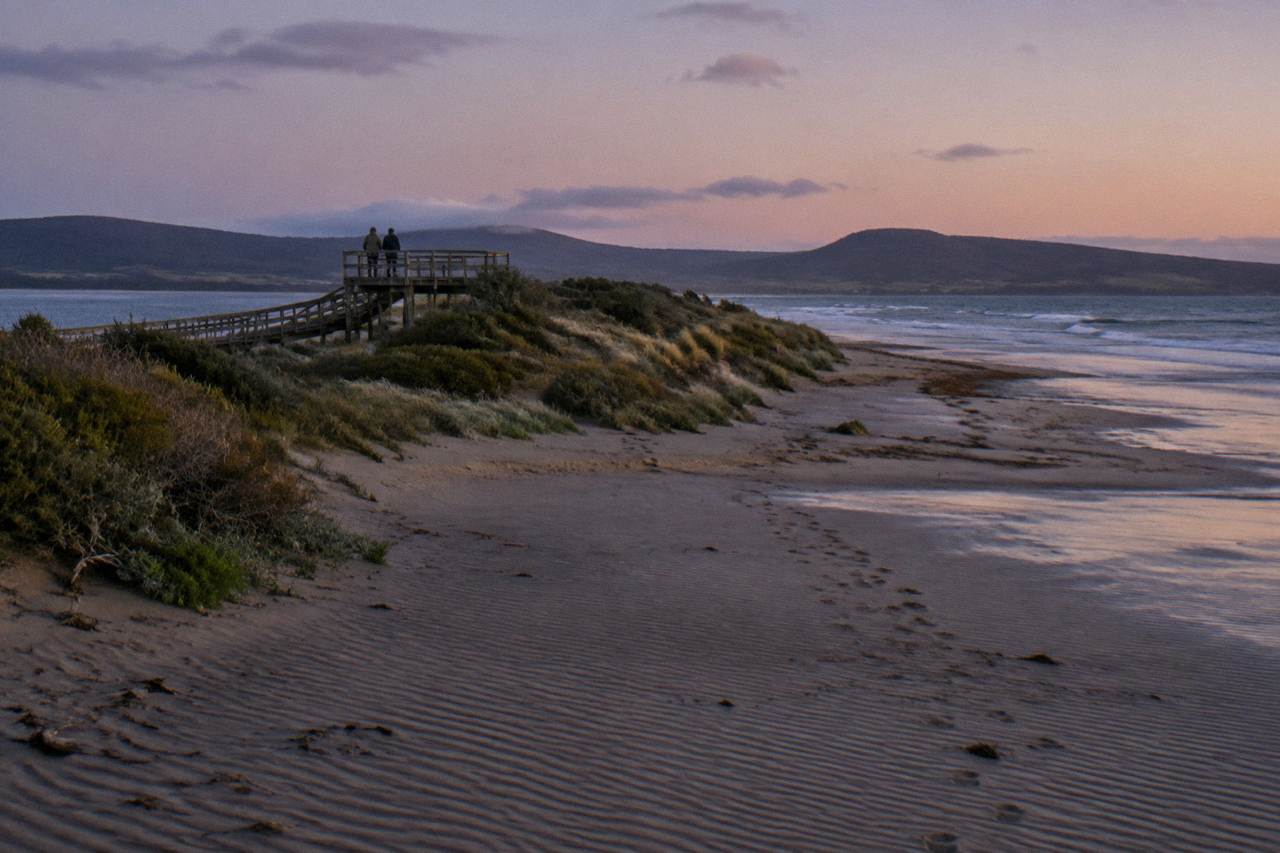
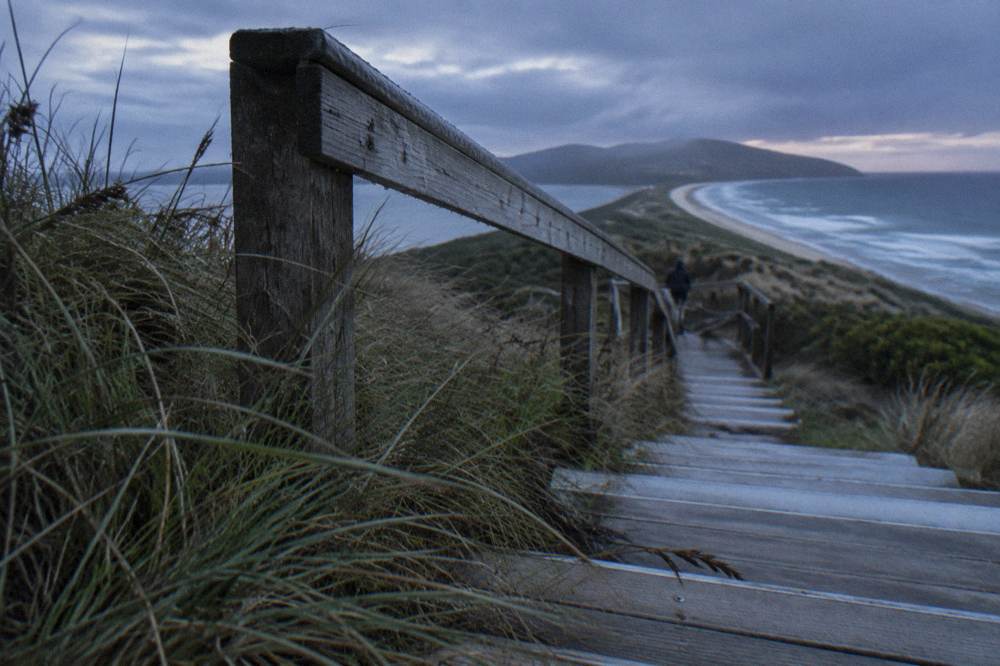
The recognized spot is the viewing platform at the Bruny Island Neck Conservation Area, the narrow sand and dune spit joining north and south Bruny. The Parks and Wildlife Service Tasmania seabirds page names this specific platform as a place where little penguins and shearwaters can be seen at dusk. It sits above the dunes on a boardwalk with steps, and it is the sanctioned vantage point, keeping people off the beach and away from the burrows.
The Neck is the island's signature landscape: a slender isthmus with a long sandy beach on either side, a timber staircase climbing the dune, and water on three horizons. The penguins and short-tailed shearwaters nest in burrows through the dune system here, and the conservation area exists largely to protect those colonies. Around 120 bird species have been recorded on the island, and the Neck is where two of its most visited residents, the penguins on the sand and the shearwaters overhead, share the same real estate.
Standing on the platform rather than the beach is not a suggestion, it is the core of the whole arrangement. The dunes are riddled with burrows, and a burrow roof collapses under a single footstep, with the bird inside. From the platform you look down across the beach and the water, which is exactly the angle you want anyway: penguins land in groups, called rafts, in the shallows, then dash up the sand in waddling lines. It is a show best watched from above.
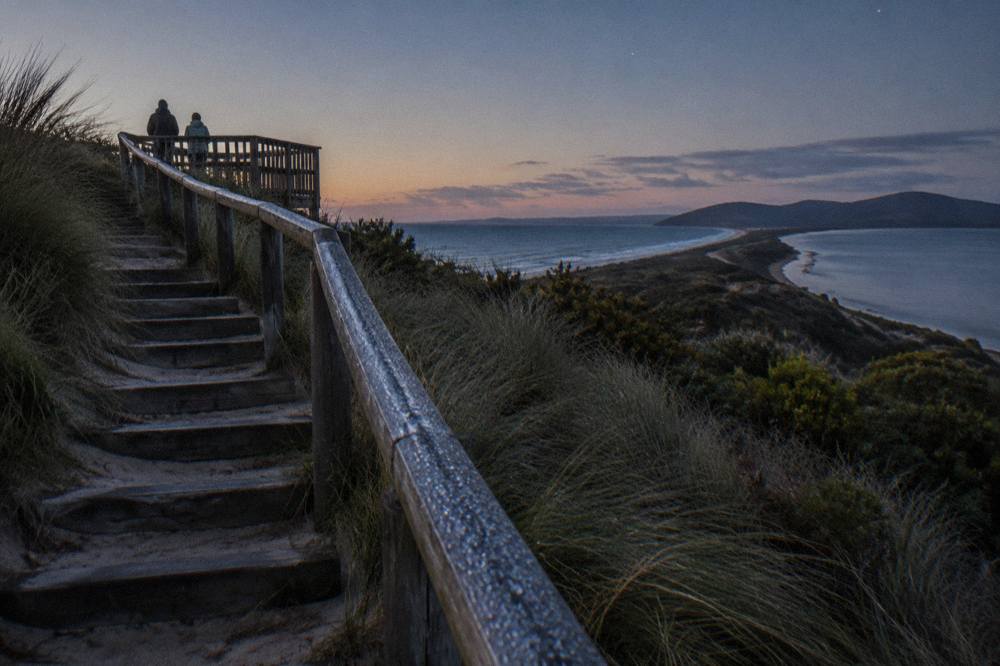
Getting there is its own small planning exercise. The Neck sits roughly midway along the island's main road, so it is reachable whether you base yourself in the north around Dennes Point or in the south near Adventure Bay. If you are driving yourself, note that parking at the Neck fills on summer evenings, and that after the viewing the drive back to your accommodation will be in the dark on unlit rural roads, so drive slowly and expect wildlife on the road. Anyone wanting the deeper background on the isthmus, its lookouts and its colonies can read the companion guide to The Neck and its lookouts, and the dedicated Bruny Island penguins guide covers the biology in more detail.
The Official Penguin Watching Rules, And Why Each One Exists
The guidelines from Natural Resources and Environment Tasmania are specific: use only a dim red-light torch, never point it at the water or the penguins, no flash cameras on the beach, approach your watching point from the land rather than along the sand, stay out of the colony itself, and remain quiet with minimal movement. Every rule maps to a penguin behaviour, and breaking one can stop a whole night's landing.
The rules can look austere on a first read, so it helps to know what each is protecting. Penguins are prey animals coming ashore in the open, and they abandon a landing if they sense movement, noise or light on the beach. A white torch beam is read as a threat; a flash is worse. Walking along the beach blocks the penguins' route from the water to their burrows, and cutting through the dunes crushes burrow entrances. Silence, stillness and red light are the price of admission, and they are not negotiable.
| Guideline | What it says | Why it matters |
|---|---|---|
| Torch light | Dim red light only, never toward water or birds | White light reads as danger and can abort a landing |
| Cameras | No flash on the beach | A flash can scatter a whole raft of birds |
| Approach | From the land, on existing tracks, not along the beach | Walking the sand blocks the penguins' path to burrows |
| The colony | Never walk through it | Burrow roofs collapse underfoot, killing birds inside |
| Noise | Stay quiet, keep movement to a minimum | Noise and motion delay or cancel the landing |
The red-light rule is the one most people get wrong, and it is the easiest to get right. A red cellophane sheet over an ordinary torch lens is explicitly acceptable under the guidelines, so there is no need for special equipment. If your torch or headlamp has a red mode, use it; if not, a square of red cellophane and a rubber band does the job. Point it at your feet and the boardwalk, never seaward.
One point of confusion is worth settling before you go. The Parks and Wildlife Service Tasmania pages do not state whether a parks pass is required for the Neck viewing platform itself, and The Neck is a conservation area rather than part of South Bruny National Park to the south. A pass is required for the national park and for Cape Bruny Lighthouse tours, but do not assume it applies at the Neck; check current arrangements with the parks service before you rely on either answer.
Shearwaters, Seals And The Rest Of The Dusk Shift
The penguins share the Neck with short-tailed shearwaters, which the parks service says nest on Tasmanian shores in late spring to late summer, arriving and departing overhead around the same dusk window. Off the island's south coast, Australian fur seals haul out around The Friars, and humpback and southern right whales pass through the surrounding marine environment on their annual migration. None of these are promised on any given evening.
The shearwaters, known locally as muttonbirds, are in some ways the more dramatic half of the Neck's dusk show. They return from feeding at sea in streaming flocks, wheeling low over the dunes before dropping into their burrows, and their calling carries across the sand. The parks service gives their nesting presence on Tasmanian shores as late spring to late summer, and that is as precise as an official source gets; no page states exact season months for the Neck colonies, so treat any month-by-month penguin or shearwater calendar you see elsewhere with caution. The full index of guides sits on Bruny Island Tasmania Tours.
Dusk on Bruny Island is generous with side attractions even when the birds are late. A white variant of the Bennett's wallaby, a local genetic curiosity, is reported by the parks service to feed in paddocks near the Fluted Cape entrance to South Bruny National Park around dusk, which puts it on the drive south from the Neck if your route runs that way. The island's beaches are unpatrolled and the coastline is wild, so keep to formed tracks and platforms as the light goes.
Do Any Bruny Island Tours Include The Penguin Hour?
None of the 14 verified tour listings on this site advertises a penguin viewing stop at the Neck, so the honest position is that the dusk hour is a self-managed one. Day tours do deliver you to the island's other highlights, the lighthouse, the producers, the coastline, and several run long enough that you could follow one with your own evening at the platform if your transport allows.
That gap in the market makes sense once you know the timing. The full-day coach and minibus tours return to Hobart by early evening, and a last-light commitment on the island means either driving back in the dark or staying overnight. If you want both a guided day and the penguins, the workable pattern is a tour that finishes in Hobart, dinner, then a self-drive return, or simply an overnight stay on the island with the tour on one day and the Neck on the other. The Bruny Island accommodation guide covers where that second night can happen.
The featured listing for this article is the Tassie Tours full-day guided tour from Hobart, a 10-hour minibus day for up to 20 guests with hotel pickup in the Hobart CBD, the round-trip ferry, live commentary and the National Parks Pass, with food paid for separately. It rates 4.7 from 938 reviews and costs from A$180 per person, one of the lowest-priced full-day guided days on the roster, and one guest review captures the tone: "The tour guide,Skye was amazing.She was polite,clear instructions, informative and accommodating." It will not put you at the platform at last light, but it hands you a full Bruny day, oysters and all, before your own evening. Another guest on the same tour wrote, "Amazing oysters at Get schucked - don't miss it!"
If your heart is set on the water rather than the road, the combined coach-and-boat day deserves a look.
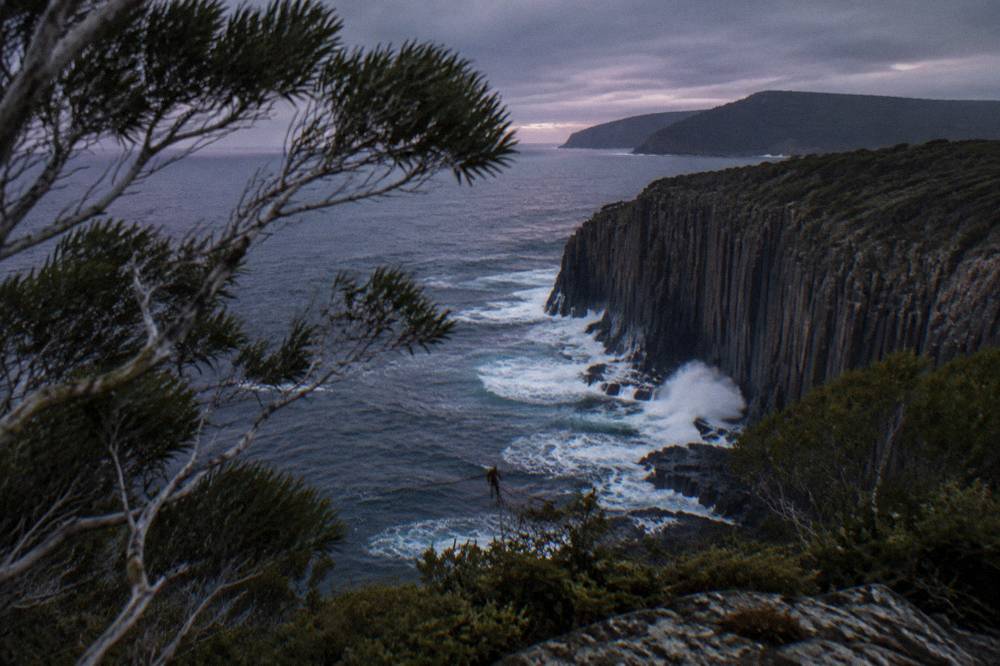
The Pennicott wilderness coast cruise and day tour pairs a guided bus day with a three-hour cruise past the sea cliffs and caves of the south coast, with morning tea and lunch, from A$290 per person and a 4.8 rating from 562 reviews. A guest review sums up the seaward half: "Great tour, weather was great, got my thrill ride with all the big waves, got to see wildlife and awesome scenery would highly recommend." The cruise passes the same south coast waters where seals and, in season, whales may appear, though no operator can promise either, and weather decides whether any sailing runs.
Timing A Dusk Visit Through The Year
Because last light moves, your arrival time at the platform moves with it. The Bureau of Meteorology's Cape Bruny data shows January and February as the warmest months with a mean maximum of 20.2 degrees, and July as the coolest at 12.2.
That six hour swing is the single most useful planning number in this article. In the weeks around the December solstice, last light is late enough that a penguin wait pushes toward a very late night, especially with children. Around the June solstice, the light goes early enough that you can watch the platform and still be home for a reasonable dinner, but the cold is real: the Cape Bruny mean minimum in July is 6.7 degrees, and the Neck is an exposed sand spit that funnels wind. Either way, dress warmer than the Hobart forecast suggests.
| Season | Light and temperature | What it means for the platform |
|---|---|---|
| Summer, Dec to Feb | Mean max 20.2 C in Jan and Feb | Late last light, mild but windy, biggest crowds, book or arrive early for parking |
| Autumn, Mar to May | Mean max slides from 18.9 C to 14.4 C | Comfortable evenings, earlier darkness through the season |
| Winter, Jun to Aug | Mean max 12.2 C in Jul, mean min 6.7 C, daylight about 9 hours near the solstice | Early last light and empty platform, but genuine cold on exposed dunes |
| Spring, Sep to Nov | Mean max rising from 14.5 C to 17.0 C, rainfall easing from its August peak of 85.7 mm | A middle path: earlier dark, cool but not bitter |
Rain is worth a word, because the Neck is not a fair-weather-only show. August is the wettest month on the Cape Bruny record at a mean of 85.7 mm, and March through May is quieter but damper than high summer. Rain does not stop penguins landing; it mainly stops underprepared watchers staying. A shell jacket, warm layers and a red-filtered torch cover almost every scenario the island will throw at an evening.
One more planning wrinkle: the ferry. The Island Connections (formerly SeaLink) service from Kettering runs every 20 minutes between 6.10 am and 7.00 pm, 365 days a year, with a 20 minute crossing. That last evening departure matters if you are day-tripping, because a midsummer last-light wait can outrun the final sailing. An overnight stay solves it, and it is the reason many penguin watchers book at least one night on the island.
If a lighthouse visit is part of your plan for the following morning, the short guided climb can be booked directly.
The 30-minute Cape Bruny Lighthouse tour costs from A$25 per person, rates 4.9 from 316 reviews, and takes up to 10 guests up the 1838 tower, with binoculars provided; the parks pass and your own transport to the cape are not included. The lighthouse grounds at the island's southern tip are about an hour and 15 minutes' drive from the ferry terminal at Roberts Point, so it pairs naturally with a southern-island day before an evening at the Neck.
How To Build The Rest Of The Day Around The Evening
A good penguin day works backwards from last light: reserve the late afternoon and evening for the Neck, and fill the morning and early afternoon with the island's south, where the lighthouse, the producers and the coastline cluster. If a guided day does the filling, the Tassie Tours full-day tour from Hobart is one of the roster's lowest-priced guided options at from A$180 per person, with free cancellation up to 24 hours before the tour.
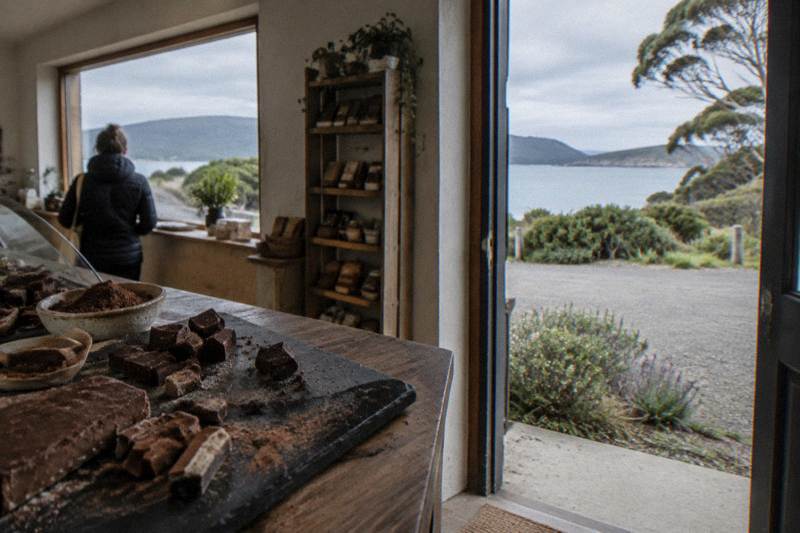
The geography argues for a southern focus. The Neck sits at the island's waist, so anything you do in South Bruny National Park, the Fluted Cape track, the lighthouse, Cloudy Bay, empties you conveniently northward toward the platform as the afternoon fades. The food producers thread the same corridor: Bruny Island Cheese Co's cellar door opens 10 am to 4 pm daily with its kitchen to 3 pm, and Get Shucked, the Honey Pot and the Chocolate Co all open daily, so a tasting circuit ends within a short drive of the dunes. The Bruny Island producers guide maps that circuit in full.
What you carry to the platform is short: warm layers, a windproof layer, water, a red-filtered torch, and binoculars if you have them. What you leave behind matters more: white-light torches, flash photography, drones and dogs. Dogs are a hard no around penguin colonies in any season. The platform itself has the boardwalk and the view; the Neck campground sits nearby, which is one way to be within walking distance when last light arrives, and the Bruny Island camping guide covers fees and sites, including the change to per-site pricing on 3 November 2026.
Conditions change on any wild coast, and tracks, access roads or facilities can close at short notice. Before any visit, check the Parks and Wildlife Service Tasmania alerts page, and read the official penguin watching guidelines themselves. The parks service's seabirds and shorebirds page is the source that names the Neck platform, and this whole article stands on those three pages.
Common Questions About Penguins At Bruny Island
What Time Do The Penguins Come In At Bruny Island?
At last light, whenever that falls on the day you visit. The official guidelines state that penguins leave the water in the evening at last light so they are under the cover of darkness; no official source gives a clock time.
Where is the best place to see penguins on Bruny Island?
The viewing platform at the Bruny Island Neck Conservation Area, named by the Parks and Wildlife Service Tasmania as a place where shearwaters and little penguins can be seen at dusk. Watch from the platform, not the beach, and keep out of the dune colony entirely.
What are the penguin watching rules?
Red-light torches only and never toward the water or the birds, no flash cameras on the beach, approach from the land on existing tracks, never walk through the colony, and stay quiet with minimal movement. The guidelines are published by Natural Resources and Environment Tasmania.
Can you see penguins all year at The Neck?
Little penguins are resident in Tasmanian waters, but no official page states exact viewing season months for the Neck colonies, so this site does not either. The short-tailed shearwaters that share the Neck are present on Tasmanian shores from late spring to late summer.
Is there a tour that takes you to see the penguins?
None of the 14 verified listings on this site advertises a penguin viewing stop. The workable pattern is a guided day tour of the island's other highlights, such as the Tassie Tours full-day tour from A$180 per person, followed by your own evening at the platform, or an overnight stay so the timing is unhurried.
How long should you stay at the platform?
Arrive comfortably before last light, at least half an hour, and be prepared to wait, since the birds land when the darkness is deep enough. On bright summer evenings that can mean a late finish; dress for wind and cold even in January, because the Neck is an exposed sand spit.